

By Rey Treviño III, President, Pecos Energy; host of The Crude Truth
Opinion. Market facts are linked to their sources; the views are the author’s. This follows up on the Energy News Beat Global Markets Weekly. Bold bracketed notes are review flags for the author and must be removed before publishing.
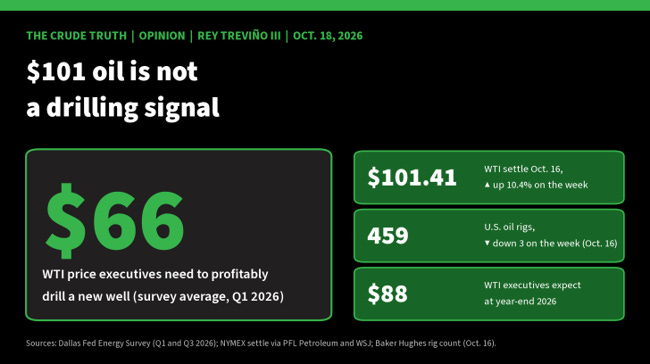
WTI settled at $101.41 on Friday, up 10.4% on the week. Every time oil crosses $100, somebody asks me the same question: “So you guys are drilling everything you’ve got, right?”
No. And the reasons why matter for your wallet as much as for ours.
Stu Turley’s weekly roundup at Energy News Beat covered what moved fuel prices: the mines in the Strait of Hormuz, Russian refinery fires, the SPR offer, and the gas gap with Europe. I want to take those same four headlines and look at them from where I sit, on the operator’s side of the wellhead.
I will be back on the Energy News Beat Stand Up on Thursday and provide boots-on-the-ground viewpoints for his listeners.
1. The price on the screen is not the price we plan on
Back in July, with Brent back at $100, I wrote that at Pecos Operating we saw it as a short-term spike and were not changing our drilling programs. That is still the right way to think about it.
Here is the math. In the Dallas Fed’s first-quarter survey, executives said they need about $66 WTI to profitably drill a new well. Large producers said $59. Smaller firms said $68. So $101 oil looks like a gold mine on paper. But in the third-quarter survey, the same industry, while spot WTI averaged $98.70, said it expects WTI of $88 at year-end, $79 in two years and $82 in five.
A well you spud this fall gets paid for over years, not weeks. You do not chase a war premium with a 30-year asset.
That is why I keep talking about capital discipline: growing methodically instead of drilling flat-out and crashing the market, which ends up hurting consumers.
The rig count tells the same story. U.S. oil rigs fell by three last week, to 459, even with Brent above $100 all week.
2. Hormuz raised our costs before it raised our price
There are two prices in this market. There is the paper price on the screen, and there is the physical price refineries pay to get a cargo delivered through a war zone. In a Fox 4 interview in late September, I put physical oil at $120 to $135 a barrel against about $92 on paper, because of freight, insurance and tanker day rates.
Those mines and attacks do not stay in the Gulf. UKMTO counted 12 attacks in the week to Oct. 16. That tension shows up in diesel, and for a producer, diesel is a cost line, not a revenue line. Service rigs, water hauling, sand and crude trucking all run on it. Retail diesel is $6.3224 a gallon, against $3.6365 a year ago.
The Dallas Fed survey backs this up. Lease operating expense and finding-and-development cost indexes for producers came in at 43.9 and 41.5, and every cost index was above its long-run average. The services input cost index was 60.4. One producer told the survey that service and permitting costs “are increasing dramatically” and, because they are predrill costs, they “dramatically affect the bottom line” (Dallas Fed comments).
In August I wrote that investors should treat the diesel crack, not Brent, as the cleaner signal, and that cracks above $80 into the fall would mean the shortage was still deepening. Friday’s ULSD futures settled at $4.8991 a gallon. That is about $205.76 a barrel, or roughly $104 over WTI (author’s calculation from Oct. 16 settlements). Distillate stocks fell another 2.5 million barrels in the week to Oct. 9. By that yardstick, the squeeze is not over.
3. The SPR is a loan, and loans come due
The Energy Department is offering up to 17 million barrels from the SPR, with offers due Wednesday at 11 a.m. CT. The reserve held about 283 million barrels in EIA’s latest weekly data (week to Oct. 9). I have said the SPR exchanges are one of the nearer-term levers available, and they are. But the last big offer, in June, put 40 million barrels on the table and awarded about 0.5 million.
Executives are watching the floor, too. Asked about the reserve’s absolute minimum workable level, the largest group in the Dallas Fed survey, 31%, put it between 100 and 150 million barrels.
Exchange barrels have to be returned later, with a premium. From where I sit, that is future demand for U.S. crude, not a reason to drill today. [REY: confirm/adjust – SPR payback as future demand for U.S. crude is a new position; keep only if you agree]
4. The gas gap is a reminder of what U.S. producers do for the world
European gas is trading at roughly nine times the U.S. benchmark, as the weekly laid out. At home, gas rigs rose to 133, just under a three-year high, and an estimated 20.5 Bcf/day of gas was flowing to LNG export terminals (BNEF via Barchart).
On oil, the U.S. shipped 4.57 million barrels a day of crude in the week to Oct. 9. On a recent Crude Truth episode, we talked about how lifting the crude export ban in 2015 was a critical milestone.
I have also said that banning diesel exports would hurt the energy dominance push by backing up refineries. Exports help keep our allies supplied and our own industry healthy.
The longer-term problem is supply. In August I cited Wood Mackenzie’s description of an industry that is “cash rich but capital cautious,” and I warned that the underinvestment bill may come due sooner. The Dallas Fed found that half of large producers plan to send extra cash flow back to shareholders or owners, with capital spending a distant second at 21%. Smaller firms put capital spending first, at 31% (Dallas Fed). Asked when Persian Gulf crude exports get back to normal, the most common answer was the second quarter of 2027, at 28%, and 21% said 2028 or later.
That is the tension. Discipline protects returns today. But if the industry never reinvests, the world will be short when it needs us most. The answer is permitting certainty, the kind of thing the License to Drill Act moves toward, plus more refineries so that U.S. barrels can turn into U.S. fuel.
What this means
For operators: budget for elevated diesel and service costs no matter what the screen says. I said that in August, and it is even truer now.
For investors: watch the crack spread and the cost indexes, not just the headline price. Steady cash flow beats a one-quarter windfall.
For consumers: as I told CBS News in September, “it takes diesel to get us from point A to point B.” Until demand destruction kicks in or we get more refining capacity, prices will remain the same or go up at the pump. American producers are doing their part.
The United States would be in a very different place without our great oil and gas exploration companies.
And That is The Crude Truth.
Please subscribe and share; that helps us keep rolling, and for any questions, let me know on LinkedIn or at https://pecos.energy/info/

You are speaking the truth, Rey. Thank you.
Your point that the diesel crack, not Brent, is the cleaner signal is the one airlines feel most directly, because jet fuel prices off the same distillate barrel. Delta is partly insulated by owning a refinery: it added about 13c a gallon in Q3, with roughly 40c expected in Q4 while cracks stay this wide.
The flip side is that the cushion shrinks as cracks normalise, which is also when fuel gets cheaper. At that point the question for Delta is whether fares hold as fuel eases.
My notes on Delta are here:
https://frontiersignaltech.substack.com/p/delta-can-higher-fares-survive-cheaper-f56