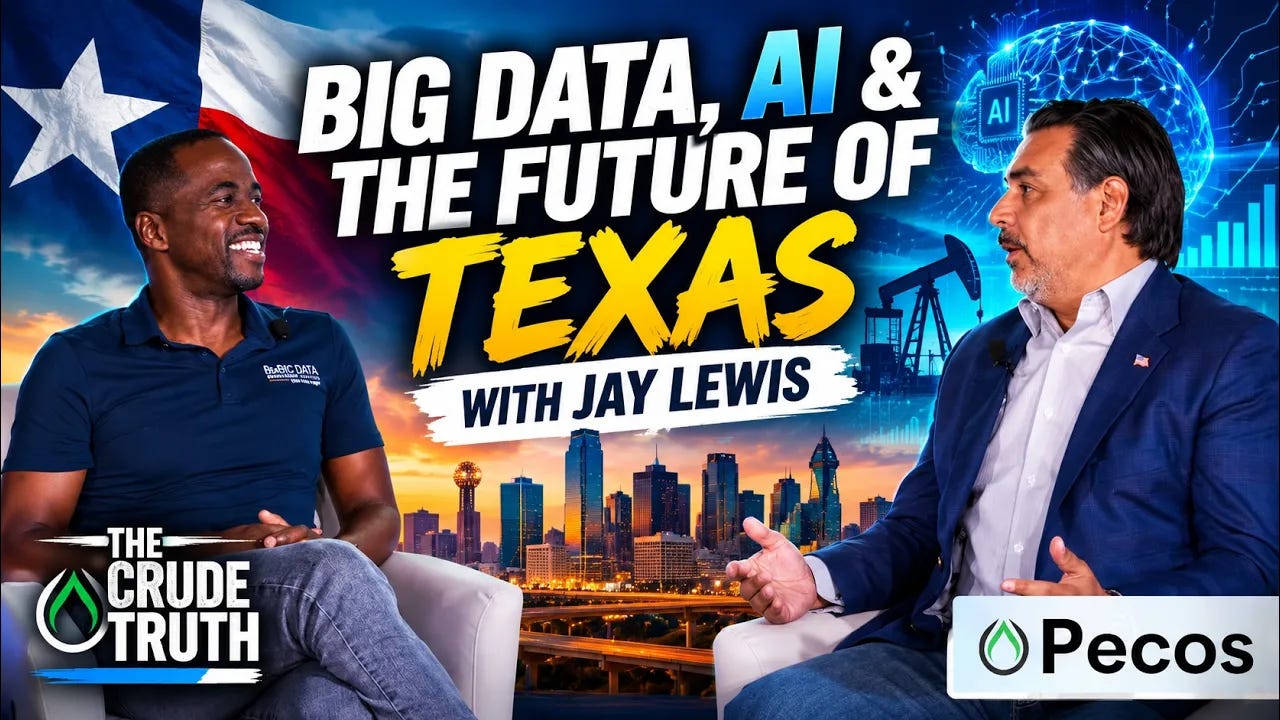
Big data is transforming the way businesses operate—and Texas is quickly becoming a major hub for data centers, AI, and the infrastructure needed to power them.
In this episode of The Crude Truth, we sit down with Jay Lewis, Founder and CEO of Big Data, to break down what “big data” really means and why clean, reliable, and secure data is becoming one of the most valuable resources in the modern economy.
Jay explains how businesses can turn data from a cost of doing business into an asset, why “garbage in, garbage out” matters, and how automation can reduce the manual work involved in gathering, cleaning, and reconciling data. We also explore the growing demand for data centers, power generation, cybersecurity, and the infrastructure needed to support AI's rapid expansion.
From oil and gas to electricity, smart technology, and business analytics, this conversation looks at how data is changing traditional industries—and why Texas is positioned to lead the way.
AI without validation is expensive but worthless. And that is the Crude Truth.
Connect with Jay Lewis on LinkedIn here: https://www.linkedin.com/in/james-lewis-138242162/
Check out BigData.com’s site here: https://bigdata.com/

Topics discussed:
1. What is Big Data?
Jay Lewis, founder and CEO of Big Data, explains that big data is fundamentally about the speed, volume, and variety of data available today. Unlike the past, when data queries took 9-12 hours, modern queries take just 2 minutes. The term encompasses the ability to collect, process, and analyze massive amounts of information from multiple sources in real time.
2. Data Centers and AI Infrastructure in Texas
A significant focus is on the explosion of data centers being built across Texas and the country. These facilities are essential for supporting AI and processing the exponential growth of data. The discussion highlights Texas’s position as a leader in this infrastructure development and the challenges of building the necessary power generation and cooling systems to support them.
3. Data as a Business Asset
The conversation emphasizes transforming data from a cost of doing business into a valuable business asset. Big Data’s role is to ensure data flows efficiently, securely, and in the right format between systems, enabling companies to use data for automation, analytics, and AI applications.
4. The Challenge of Data Quality (”Garbage In, Garbage Out”)
A recurring theme is the importance of data accuracy and integrity. The speakers discuss how small errors—like Excel corrupting leading zeros or miscalculating large numbers—can cascade into millions of dollars in losses. They emphasize the need for quality checks at every step of the data pipeline, not just at the end.
5. Real-Time Monitoring and Efficiency
Using oil and gas operations as an example, the discussion explores how real-time data collection (e.g., pressure readings multiple times daily instead of twice monthly) enables better decision-making and operational efficiency. This applies to various industries, from utilities to energy production.
6. Data Reconciliation and Cost Savings
The speakers highlight how daily reconciliation of data—rather than waiting until month-end—can dramatically improve cash flow, customer experience, and profitability. They cite examples of how undetected data errors can result in losses of $10 million to hundreds of millions of dollars over time.
7. The Ideal Client for Big Data Services
Companies with multiple trading partners and numerous data feeds are the primary targets. As complexity increases, so do manual errors. Big Data helps automate and streamline these processes, reducing the “invisible engineering” work that often goes unnoticed by executives.
8. Information as America’s Most Important Resource
The interview concludes with a philosophical discussion about how information and data have become America’s most critical resource—surpassing oil, gas, and even national security in importance. The speakers emphasize the need for proper guardrails, credibility, and reliability in data management to maintain competitive advantage.
9. Public vs. Private Data Infrastructure
There’s discussion about how government and private sector initiatives must work together to build the necessary infrastructure for data centers, balancing the need for resources, financing, and security.
This episode essentially positions big data management as critical infrastructure for the modern economy, particularly in Texas, where energy and technology sectors are converging.
Thank you to our sponsors: LFS Chemistry, NAPE Expo, Air Compressor Solutions, Sandstone Group, Exec Crew, Texas Star Alliance, Pecos Country Operating, and Real News Communications Network.
Subscribe to The Crude Truth for more conversations about energy, business, technology, and the future of Texas.
For More information on Tax-Advantaged Investments: https://pecos.energy/info/
Check out LFS Chemistry, sponsor of the Crude Truth, here:
Air Compressor Solutions https://acsir.com/
Follow Rey on LinkedIn: https://www.linkedin.com/in/reytrevinoiii/
Also, Pecos Operating Website: https://pecos.energy/