

With the national average diesel at roughly $6.28 per gallon and regular gasoline around $4.36 (AAA, October 11, 2026), and jet fuel costs elevated at both wholesale and retail levels, American drivers, truckers, airlines, and heating-oil customers are feeling the squeeze weeks before the November 3 midterms. (Source AAA Gas prices)
Prices have risen sharply amid the Iran conflict that began in late February 2026, Ukrainian strikes on Russian refining capacity, domestic refinery idling and closures (especially in California), and logistics constraints. Diesel is up dramatically year-over-year; every additional dollar per gallon costs independent truckers hundreds of dollars per week. Heating oil fill-ups in the Northeast are far more expensive. These costs flow into groceries, shipping, air travel, and household budgets.
The Defense Production Act (DPA) of 1950 gives the President tools to expand critical industrial capacity for national defense. On April 20, 2026, President Trump signed a Presidential Determination under Section 303 covering domestic petroleum production, refining, and logistics capacity (including pipelines, storage, and marine terminals). He declared this essential to national defense, waived certain Title III conditions under a national energy emergency, and directed the Energy Secretary to use purchases, commitments, and financial instruments to expand capacity. (Source White House)
The White House has realigned roughly $1 billion in DPA funding to the Department of Energy. So far, significant awards have gone toward coal plants and related infrastructure rather than refining. The White House has met with refiners and is reportedly preparing directives to use the DPA more aggressively to raise oil and fuel output while bypassing certain state and local barriers. (Source Reuters)
What the DPA Can—and Cannot—Deliver Before the Midterms
The DPA enables rated orders that prioritize materials (Title I), direct financial support and offtake commitments for capacity (Title III), and voluntary agreements among companies (Title VII). It can help preempt some state-level obstacles, as seen in litigation around other energy orders. It does not grant broad eminent domain for oil pipelines (unlike natural gas under FERC), waive the Jones Act, or override federal statutes such as NEPA.
New greenfield refineries will not deliver barrels by Election Day. The proposed America First Refining project in Brownsville, Texas (roughly 164,000–168,000 barrels per day), targets mechanical completion in late 2028 and full operations later, with no final investment decision and supporting infrastructure still needed. U.S. operable refining capacity stands at about 18.16 million barrels per calendar day across roughly 130 plants (down from far higher numbers decades ago); the last major new refinery of significance dates to the 1970s.
Faster options exist for restarting or expanding existing or recently idled capacity. Valero’s Benicia, California, facility (~145,000 b/d) was fully idled in April 2026 after a phased shutdown; permits have been maintained, creating a potential restart pathway if economics and regulatory hurdles are addressed. The long-idled St. Croix refinery in the U.S. Virgin Islands is targeting a phased 2027 restart that could eventually exceed 200,000 b/d, with interest from private partners, crude supply arrangements, and federal coordination. Prior restart attempts faced cost overruns and regulatory issues, so success is not guaranteed.
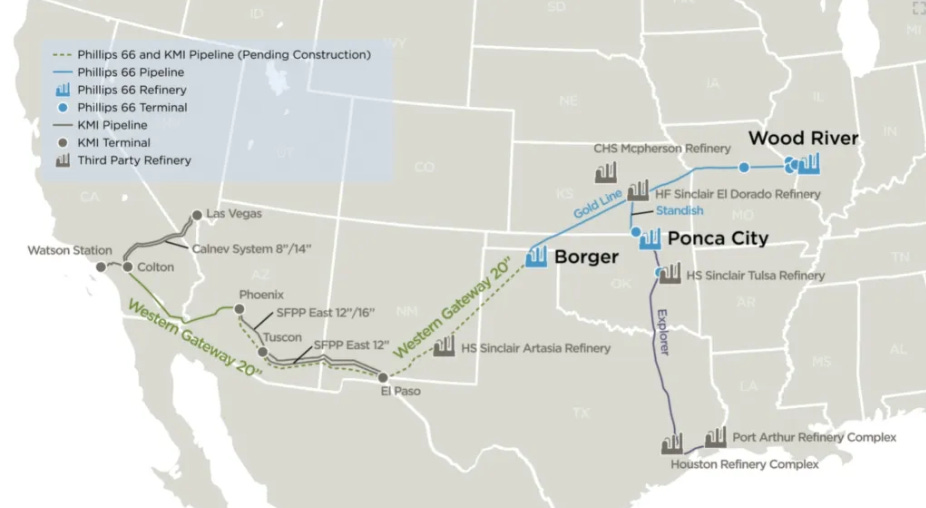
Pipeline projects (such as the Western Gateway line shown above) and material prioritization can improve longer-term logistics, but steel priority ratings and funding do not immediately increase physical capacity. Demand destruction is already visible in some distillate and gasoline consumption figures relative to recent averages, and refiners have enjoyed strong margins amid the crunch.
Other non-DPA levers offer nearer-term relief: Strategic Petroleum Reserve exchanges (up to tens of millions of barrels authorized or offered), temporary EPA fuel standard flexibility (such as E15 or winter-grade gasoline), the already-issued dyed diesel tax deferral and highway use allowance, and a broader or extended Jones Act waiver. The current narrowed waiver (through mid-November) has reduced foreign-flag domestic energy shipments from Gulf Coast refining centers to the East and West Coasts after August 2026 changes, cutting flows by hundreds of thousands of barrels per day in some estimates. Widening it again could move more domestic fuel more cheaply and quickly to deficit regions.
EIA forecasts point to lower average prices in 2027 if supply normalizes, but that is after the midterms. Geopolitical factors (Iran, Ukraine/Russia refining losses) remain outside pure domestic control, even with record U.S. production, the large Venezuela oil arrangement, and LNG export growth.
A Practical Plan the Administration Can Put Before Voters Now
President Trump cannot wave a wand and drop pump prices by Election Day through new refining capacity alone. He can announce and begin executing a clear, multi-track plan that delivers some near-term supply flexibility, signals durable capacity growth, and gives voters a concrete alternative to past policies that contributed to refinery closures and constrained logistics.
He really needs to get in front of the narrative and push one rather than have the Democrats suck all the air out of the room with false narratives.
Recommended elements, executable in the remaining weeks and structured for messaging:
Immediate logistics and short-term supply actions (weeks, not years): Extend a broader or more flexible Jones Act energy waiver beyond the current November 15 horizon, with streamlined approvals for Gulf-to-coast shipments of gasoline, diesel, and jet fuel. Maximize remaining SPR exchange volumes and coordinate temporary fuel specification waivers where they safely increase usable supply. Publicly track and report the volumes moved.
DPA offtake and restart acceleration: Within days, issue or announce DOE Title III offtake commitments, loan guarantees, or purchase agreements targeting the highest-probability restarts and expansions (Benicia pathway if viable, St. Croix financing and regulatory coordination, incremental expansions at operating Gulf Coast plants). Prioritize DPA-rated orders for critical steel and components for any shovel-ready pipeline or terminal work. Publish the criteria and timeline so markets and the public see action.
Renew the DPA before it sunsets: Most core authorities expire in late 2026 (reports and statute point to around September 30 or December 11, depending on the exact provision and recent extensions). Push Congress for the five-year renewal already advanced in the House (H.R. 7688, the DPA Modernization Act) so the tools remain available. Tie it explicitly to energy security and consumer affordability.
Transparent capacity roadmap and accountability: Release a short public scorecard of operating refining capacity, planned restarts/expansions, expected first barrels, and supporting infrastructure. Contrast with the long-term decline in the number of U.S. refineries and the regional concentration (Texas and Louisiana hold roughly half of capacity). Many closures occurred under prior regulatory environments, including in states that voted for Trump in 2024.
Messaging that meets voters where they are: Frame the plan as “Energy Dominance for Lower Costs”—record production and exports already achieved, geopolitical shocks being managed, and now targeted use of Cold War-era tools to rebuild refining and logistics muscle that was allowed to atrophy. Acknowledge that full relief takes time (restarts measured in months to a couple of years, greenfield longer) while highlighting every barrel of near-term flexibility. Pair it with the existing National Energy Dominance Month proclamation and prior deregulatory steps. Polling shows weak approval of gasoline prices and the cost of living; a specific, dated plan with early, visible steps is more credible than general promises.
This approach uses the authority already signed, the funding already moved, and the short-term levers already tested. It does not require new legislation for the core near-term steps and positions the administration to claim progress even if large new barrels arrive after November. Markets respond to credible offtake and regulatory certainty; voters respond to a plan that treats high fuel costs as a solvable supply-and-logistics problem rather than an inevitability.
The barrels that matter most in the next few weeks are those that can move under a broader shipping waiver or from existing inventories and flexibility. For 2027–2029, the capacity that matters is the capacity the DPA can help de-risk and prioritize starting now.
Putting that distinction, and the concrete steps, in front of the public before the midterms is both feasible and politically useful.
As always, please get in touch with me at https://pecos.energy/info/, or on my LinkedIn at https://www.linkedin.com/in/reytrevinoiii/
Also, consider subscribing to the Crude Truth Substack and our YouTube channel below. We are trying to get the Crude Truth in front of as many consumers as possible. There's a lot of noise out there, and people want the truth.

Very sound advice for the President. Unfortunately, whenever I manage to hear him talking it’s generally about “fake news” or faulty polling data or how his approval ratings are biased and he’s not really getting a 30ish percent approval rating. He has so many good ideas in energy policy, and a lot of really good things have been accomplished too. But he shows over and over he can’t stop bragging about himself in order to clearly outline the topics you just covered. He and the country would be much better served if he could state the objectives, how we achieve them, and a realistic timeline to do so. Maybe you guys can wink 😉 to Secretary Wright about your ideas🙏
President Trump is promoting Ukraine to cease drone attacks on Russian refineries but remains silent on the California over-regulations that will result in several of the 7 remaining refineries in California to close and reduce the supply chain of ALL TRANPRATION FUELS.
Implementing the Defense Production Act (DPA) would permit the Federal Government to keep those 7 operation refineries in the 4th largest economy in the world OPEN and prevent a National Security Risk to America, as closure of California refineries would place the dependency for jet fuel to meet the demands of the State’s 40 military airports and 9 international airports onto refineries located in foreign countries.