

As global conflicts disrupt shipping lanes and drive up transportation costs, what does the future hold for America’s maritime industry and energy security?
In this episode of "The Crude Truth," host Rey Trevino III sits down with Dr. Beatriz Canamary, founder of the American Maritime Industrial Coalition, to discuss the critical state of U.S. maritime shipping in an increasingly volatile global landscape.
With geopolitical tensions in the Strait of Hormuz, the war in Ukraine, and shipping costs at historic highs, the conversation explores why America's maritime industry—once a global shipbuilding leader—has declined to just 0.4% of the commercial fleet. Dr. Canamary explains how the current administration is treating maritime dominance as a national security imperative and discusses cutting-edge innovations like autonomous ships and nuclear propulsion that could restore American leadership at sea while securing the nation's energy future. Dr. Beatriz Canamary
1. Global Shipping Disruptions & Geopolitical Conflicts
The podcast opens with the Iranian conflict and the war in Ukraine creating significant turmoil in global shipping lanes. These conflicts are driving up shipping costs and creating uncertainty in the industry. The Strait of Hormuz and other critical shipping routes are being weaponized as tools of trade warfare.
2. The Decline of U.S. Maritime Industry
Dr. Beatriz Canamary explains how the U.S. went from being the world’s leading commercial shipbuilder before WWII to representing only 0.4% of the global commercial fleet today. After WWII, the U.S. shifted focus to military warships, while China now produces 72-80% of the global commercial fleet.
3. National Security & Maritime Dominance
The podcast emphasizes that rebuilding U.S. maritime capacity is a national security priority. The current administration has signed executive orders and published strategies focused on restoring American maritime dominance, with bipartisan congressional support through multiple bills.
4. The American Maritime Industrial Coalition (AMIC)
Dr. Canamary discusses the coalition she founded with five other maritime leaders to convene industrial players, map U.S. capacity, and advocate for maritime prosperity. AMIC works to bridge government policy with industry needs.
5. Next-Generation Maritime Technologies
Key innovations being discussed include:
Autonomous ships (commercial autonomous surface ships are being regulated by the IMO)
Nuclear propulsion systems for ships
Floating nuclear power plants for energy supply
Physical AI applications in shipyards and ports
6. The Connection Between Oil & Gas and Maritime
The podcast highlights how oil and gas production depends on shipping infrastructure. With 120+ empty tankers moving to the U.S. Gulf Coast in April due to Strait of Hormuz blockages, the energy sector directly drives cargo demand for U.S.-flagged vessels.
7. Shipping Costs & Insurance Premiums
Insurance costs have skyrocketed from 2-3% to 7-10% of total shipping costs during the current geopolitical crisis—a 3-5x increase. This directly affects global oil and goods prices. This is one of the key differences between paper and physical delivery, as we crossed into tanker rates over $1 million per day, adding huge costs to refinery delivery prices.
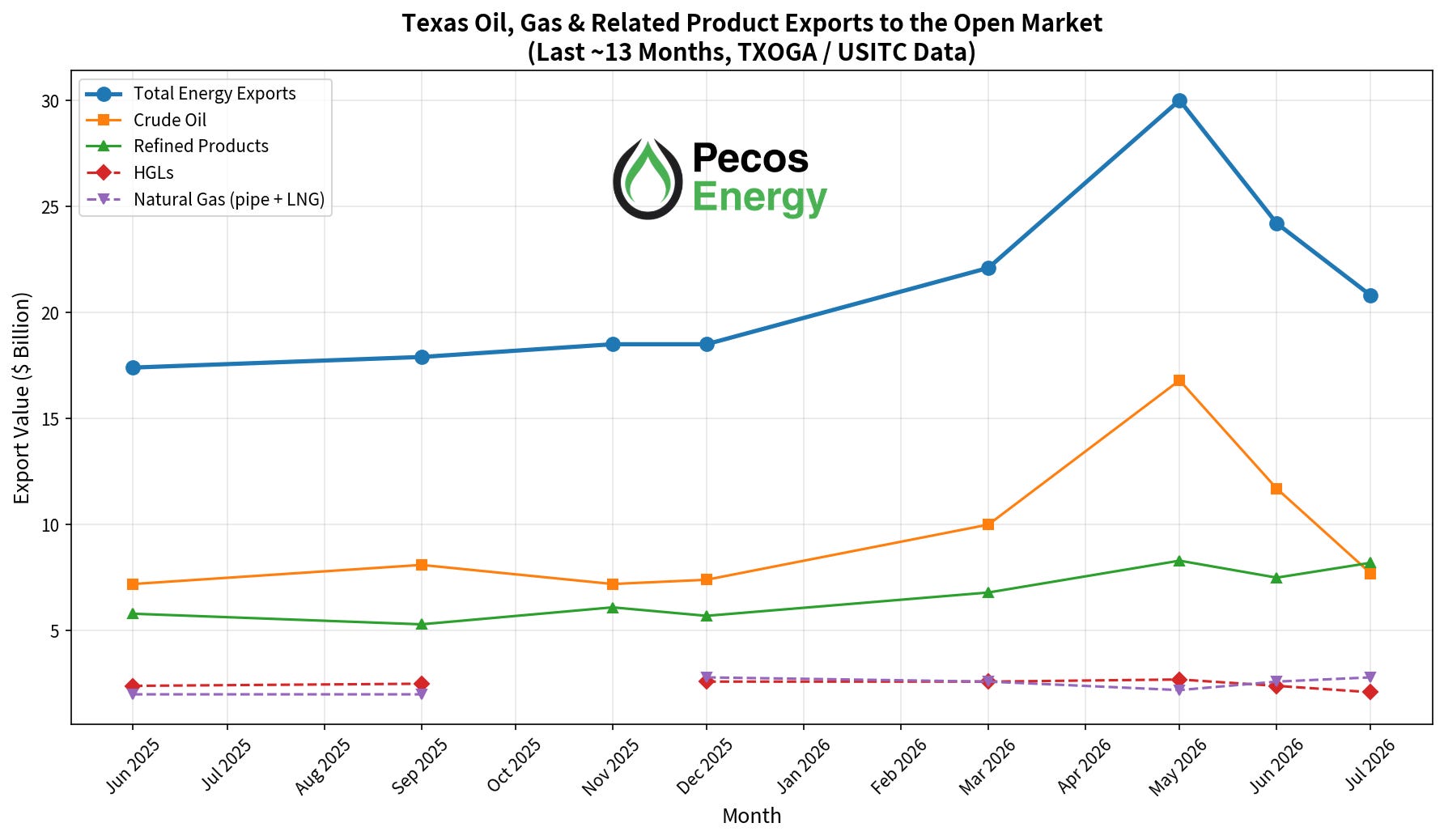
Late 2025: Exports were relatively stable near $17.4–18.5 billion/month (e.g., June 2025: $17.4B; September: $17.9B; November/December: $18.5B). Crude oil and refined products dominated, with natural gas (pipeline + LNG) and HGLs making up the rest.
Spring–summer 2026: Values rose sharply, peaking at about $30 billion in May 2026 (crude alone ~$16.8B), driven by higher global energy prices and solid volumes. June was $24.2B and July $20.8B (still elevated vs. prior years, up year-over-year).
Product mix: Crude oil and refined products usually account for the largest shares. Natural gas exports (LNG + pipelines, mainly to Mexico) have been in the ~$2–2.8B range; LNG volumes from Texas terminals (e.g., Corpus Christi, Freeport) have been strong, often in the 8–10+ Bcf/d range alongside pipeline flows.
Context: Texas accounts for a large majority of Gulf Coast (PADD 3) crude exports (frequently 3.5–5.6 million barrels per day in recent EIA data) and a major share of U.S. LNG. Destinations typically include Europe and Asia-Pacific for crude/LNG/HGLs and Latin America/Mexico/Canada for refined products.Eia
These figures represent commercial exports to the open market (USITC trade data by origin of movement). Volumes have remained robust amid near-record Texas production (crude often ~5.7–5.8 Mb/d; marketed gas ~34–36+ Bcf/d). Full monthly series and volume details are available in TXOGA reports and EIA PADD 3/USITC statistics.
8. Texas as the Maritime Hub
The discussion emphasizes Texas’s central role in the U.S. maritime, energy, and oil & gas industries, with major ports in Houston and Corpus Christi serving as critical infrastructure.
Texas energy export facilities and ports have grown substantially over the last two years (roughly 2024–2026), driven by deeper channels, more storage, pipeline takeaway, and LNG capacity. These changes support higher crude, refined product, NGL, and LNG volumes to open markets and align with the elevated export values noted earlier.Maritime-executive
Port of Corpus Christi (largest U.S. crude export hub)
This has been the primary growth area. The multi-phase Corpus Christi Ship Channel Improvement Project (roughly $625 million) was completed, deepening the channel from 47 feet to 54 feet MLLW and widening it from 400 feet to 530 feet (with barge shelves). This allows fuller loading of larger vessels such as Suezmaxes and improved VLCC operations, cutting the need for offshore lightering and projected to save exporters over $200 million annually in transport costs. The port handles more than 2.4 million barrels per day of crude exports (often cited as ~60% of U.S. crude exports) plus significant LNG.Maritimeprofessional
Key related expansions:
Enbridge Ingleside Energy Center (EIEC), the largest U.S. crude storage and export facility by volume: Phase VII added ~2.5 million barrels of storage (total capacity now ~20 million barrels). It has four deep-water berths (two VLCC-capable) and high loading rates (~200,000 barrels/hour). Gray Oak Pipeline expansion (~120 kb/d total, phased through 2025–2026) brought capacity to ~1.02 Mb/d. Additional dock acquisitions and high utilization from Permian/Eagle Ford pipelines (Cactus system, etc.). EIEC has loaded ~1.1+ Mb/d at times.Enbridge
Pipeline capacity additions to the Corpus corridor: Gray Oak + Cactus III (Plains All American +75 kb/d) together added nearly 200 kb/d of takeaway, relieving prior high utilization (often 90–100%).
Cheniere Corpus Christi LNG: Stage 3 (seven midscale trains) reached completion in August 2026, adding ~1.3 Bcf/d nominal capacity (~1.5 Bcf/d peak). This brought the facility to ~3.1 Bcf/d nominal (second-largest U.S. LNG terminal after Sabine Pass). Production ramped from late 2024 onward. Midscale Trains 8–9 are under construction (targeting ~2028, +~0.4 Bcf/d nominal). Stage 4 is in the FERC process (larger potential addition). A DOE authorization also supported further export growth.Bit
Port throughput has been strong, with crude and LNG driving gains in recent quarters and record or near-record tonnage in 2025–2026 periods.
Houston Ship Channel / Port Houston
Project 11 advanced significantly. Port Houston completed its portions (widening the Galveston Bay reach from 530 feet to 700 feet), celebrated in early October 2026. This improves two-way traffic, safety, and efficiency for larger vessels and removed some daylight restrictions. Remaining U.S. Army Corps of Engineers segments continue (full completion targeted around 2029), including further deepening in places. Crude oil exports via the channel rose sharply (reports of ~40% year-over-year in early 2026 periods), and overall export tonnage was up ~21% through mid-2026 in some data. Houston remains a major gateway for crude, refined products, and NGLs.Maritime-executive
Freeport LNG and other
Freeport LNG completed a debottlenecking project that added roughly 1.5 mtpa (raising effective capacity toward ~16.5 mtpa from the original three-train ~15 mtpa). Train 4 (~5 mtpa) has faced repeated delays (related to the 2022 incident and commercialization); FERC extended the in-service deadline to December 2031, and major construction has not advanced substantially.Enerdata
Other activity includes advancing deepwater export concepts (e.g., Sentinel Midstream’s Texas GulfLink offshore near Freeport, targeting full VLCC loading and commercial operations around Q4 2028 after receiving key approvals) and private Ingleside-area assemblages securing permits for additional VLCC berths and large-scale tankage.
These expansions (especially channel improvements at Corpus Christi and Houston, plus storage/pipeline and LNG train additions) have raised the practical export ceiling for Texas energy products. Corpus Christi has solidified its lead as the top U.S. crude export port, while Houston continues to handle large volumes of crude, refined products, and NGLs. Further growth is expected from remaining LNG trains and pipeline/dock work, though new large greenfield deepwater terminals are still years away. Data come primarily from port authorities, Enbridge, Cheniere, EIA, and industry reports.
9. Shipping Insight Conference 2027
The podcast promotes the upcoming Shipping Insight conference (October 13-14 in Houston) focused on “Project 2027”—a strategic initiative to rebuild American maritime capacity through coordinated action among cargo owners, investors, shipyards, and government.
Connect with Dr. Canamary on LinkedIn: https://www.linkedin.com/in/beatrizcanamary/
Check out the Sure Strategy Group here: https://surestrategygroup.com/
Thank you again, Dr. Canamary, for stopping by The Crude Truth. We need more leaders like you fighting for American maritime trade. - Rey
Subscribe to The Crude Truth for more conversations about energy, business, technology, and Texas's future.

For More information on Tax-Advantaged Investments: https://pecos.energy/info/
Check out LFS Chemistry, sponsor of the Crude Truth, here:
Air Compressor Solutions https://acsir.com/
Follow Rey on his LinkedIn: https://www.linkedin.com/in/reytrevinoiii/
Also, Pecos Operating Website: https://pecos.energy/

Bad news: Diesel fuel flow recovery may take YEARS !
In February 2026, the Gulf and Russia together supplied nearly half of the world's seaborne diesel.
The loss of diesel transportation fuel refinery capacity in Russia and the Gulf from the war, and from California refinery shutdowns, may take YEARS to replace the worldwide refinery supply chain demand for diesel fuel.
Rather than support implementing the Defense Protection Act (DPA) to take over control of the refineries in the 4th largest economy in the world (California), it’s embarrassing that Trump is encouraging Russia to rebuild their damaged refineries to manufacture diesel fuel, while he remains ignorant of the continuous closures of refineries California due to over regulation of those in-state refineries.