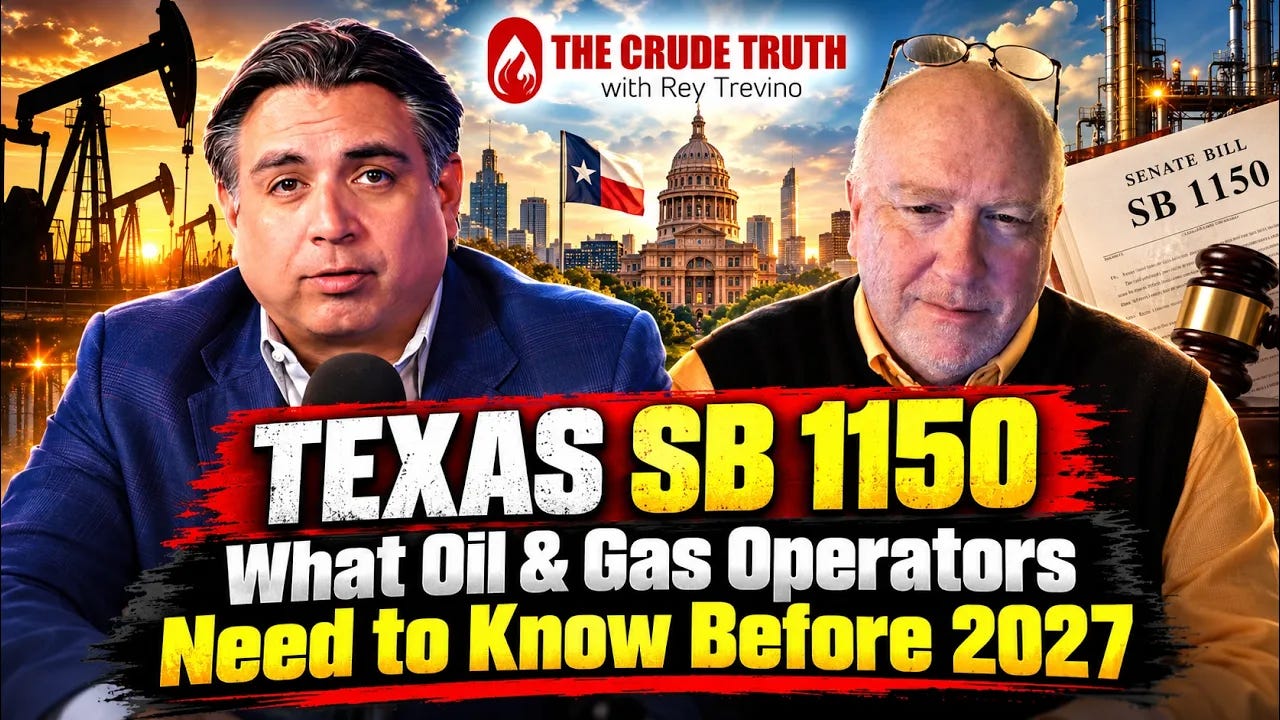
Karr Ingham, President of the Texas Alliance of Energy Producers, stops by the Crude Truth Podcast.
Texas oil and gas operators are facing a significant regulatory shift with Senate Bill 1150, which fundamentally changes how the state manages its vast inventory of inactive wells. As the energy industry continues to thrive—with Texas producing nearly 6 million barrels of oil per day and accounting for over 42% of the nation’s crude oil—a growing challenge has emerged: the state has accumulated about 120,000 inactive wells that are not producing but remain under operators’ bonds and responsibility. Senate Bill 1150 addresses this issue by requiring operators to either plug or return to service all wells that have been inactive for 15 years and were completed 25 or more years ago within a 15-year compliance window beginning September 1, 2027. With an estimated $2 billion in plugging costs looming and rising service expenses, this legislation represents one of the most significant regulatory challenges facing independent and large oil and gas operators in Texas, requiring careful planning, financial stewardship, and industry advocacy to ensure the rules are implementable and don’t inadvertently harm the state’s energy production capabilities.
Connect with Karr Ingham on LinkedIn: https://www.linkedin.com/in/karr-ingham-9b62333a/
The Texas Alliance of Energy Producers: https://www.texasalliance.org/
1. Senate Bill 1150 & Inactive Well Regulations
The central focus of the episode is Senate Bill 1150, which addresses the plugging of long-inactive oil wells in Texas. The bill targets wells that have been inactive for 15+ years and were completed 25+ years ago (referred to as “1525 wells”). The legislation aims to accelerate the timeline for either plugging these wells or returning them to service.
2. Timeline & Implementation
The bill came into effect September 1, 2025
New rules are set to take effect September 1, 2027
The Railroad Commission will adopt the final rule by December 31, 2026
Operators will have a 15-year compliance period (through 2042) to deal with their inactive well inventory
3. Financial Impact & Costs
Estimated $2 billion in plugging work needed across Texas operators
Rising plugging costs due to increased demand for plugging services
Money spent on plugging diverts resources from drilling, development, and production activities
Potential impact on energy prices for consumers
4. Key Regulatory Criteria
The Railroad Commission is evaluating operators based on:
Track record of returning wells to service
Financial stewardship and ability to pay
Financial hardship provisions for extensions
Compliance plans for managing the 15-year timeline
5. Challenges & Concerns
Non-transferable compliance timeline: If an operator sells leases before completing plugging, the new owner gets only the remaining time
Rolling inventory: New wells age into the 1525 category during the compliance period, adding to the workload
Insufficient evaluation time for operators acquiring well packages
Bond requirements and full-cost calculations for plugging
6. Industry Context & Production Growth
Texas oil production has grown from ~1 million barrels/day to ~6 million barrels/day over 15 years
Texas now produces 42-43% of U.S. crude oil
The rise in inactive wells correlates with increased drilling activity during the energy renaissance
Orphan/abandoned wells (~10,000-12,000) are relatively small compared to inactive wells (~120,000)
7. Advocacy & Operator Input
The Texas Alliance of Energy Producers played a crucial role in:
Extending the initial 10-year compliance period to 15 years
Pushing back the implementation date from September 1, 2025 to September 1, 2027
Advocating for financial hardship provisions
Encouraging operator feedback during the public comment period (ending November 13)
8. Economic & Market Implications
Reduced capital available for new development and production
Potential for new plugging service companies to emerge
Impact on property taxes and severance taxes from future production
Broader implications for energy affordability and supply
History and Summary
Senate Bill 1150 (Texas, 89th Legislature, 2025) requires operators of certain long-inactive oil, gas, and injection wells to plug them (or return them to production) rather than extending deadlines indefinitely.
Previously, operators could repeatedly get plugging extensions for inactive wells (those not producing for 12+ months) as long as basic compliance rules were met, contributing to a growing backlog that feeds into “orphaned” wells (abandoned with no solvent operator, leaving the state responsible).(Source Capitol.texas)
SB 1150 (authored by Sen. Mayes Middleton, signed by Gov. Abbott) targets “15/25 wells”: those inactive for more than 15 years and completed more than 25 years earlier. For these, standard extensions no longer apply. The Railroad Commission of Texas (RRC) may still grant extensions only under limited conditions, such as:
A demonstrated history of returning inactive wells to operation,
Proven financial hardship,
An approved compliance plan committing to plug or restore the well by around September 1, 2040/2042,
Or posting a full-cost individual performance bond covering the well’s lifetime.
The bill also adds annual testing/reporting requirements for certain long-inactive wells, requires the RRC to issue annual inactive-well reports, authorizes administrative penalties, and directs the RRC to adopt related rules. Most of the act took effect September 1, 2025, with the core plugging/extension changes effective September 1, 2027. The goal is to slow the growth of orphaned wells and shift more end-of-life responsibility back to operators.(Source Commissionshiftaction)
How Many Abandoned/Inactive Wells Might Be Impacted?
Texas has a large inventory:
Orphaned wells (no solvent operator; state plugs them): Roughly 8,300–8,600 as of 2024; the count rose to over 10,000–11,000+ by early 2026 and has been reported near or above 12,000 in some updates. These already lack operators, so the bill mainly aims to prevent new ones rather than instantly addressing existing orphans.( Source News.oilandgaswatch)
Inactive wells (still have an operator but not producing for ≥12 months): Estimates commonly range from about 100,000–120,000 to roughly 155,000–160,000. One RRC-related figure cited ~156,500 inactive wells as of August 2025. An Environmental Defense Fund analysis found roughly 22,400 inactive for 15+ years.(Source Blogs.edf)
The bill primarily affects the subset of older, long-inactive wells still tied to operators (especially the 15/25 category). Compliance plans allow a multi-year phase-in, so not all will be plugged immediately. Exact numbers of wells meeting the precise 15/25 criteria are not fixed in the legislation and depend on RRC data and rulemaking.
What This Means for Texas Residents and Consumers
Potential benefits:
Reduced risk of environmental and safety problems from aging unplugged wells, including groundwater contamination pathways, methane or hydrogen sulfide leaks, surface pollution, blowouts, or sinkholes. These can affect drinking water, property values, agriculture, and public health. (Source Houstonchronicle)
Greater industry accountability for plugging costs (often tens of thousands of dollars per well, sometimes much more), which should slow the growth of orphans that taxpayers ultimately help fund through the RRC’s plugging program (supported by industry fees, state appropriations, and federal money).
Potential costs or trade-offs:
Operators face higher compliance, testing, bonding, or plugging expenses. Some of this may be passed through in energy costs, or it could pressure smaller operators (increasing short-term bankruptcy/orphan risk in some cases). The long phase-in period (toward 2040) and exception options are intended to soften the economic impact.
More transparent reporting and oversight.
Overall, it is a bipartisan step toward limiting indefinite deferral of plugging older inactive wells while preserving flexibility for operators that can show reactivation history, hardship, bonding, or a structured plan. Critics (including some environmental groups) argue remaining exceptions and the long timelines leave loopholes; industry supporters describe it as a balanced response to a growing problem. Implementation depends on RRC rules and enforcement, which are still being developed.
Thank you, Karr, for your leadership and your positive impact on the Texas Energy Markets. - Rey
Subscribe to The Crude Truth for more conversations about energy, business, technology, and the future of Texas.

For More information on Tax-Advantaged Investments: https://pecos.energy/info/
Check out LFS Chemistry, sponsor of the Crude Truth, here:
Air Compressor Solutions https://acsir.com/
Follow Rey on his LinkedIn: https://www.linkedin.com/in/reytrevinoiii/
Also, Pecos Operating Website: https://pecos.energy/