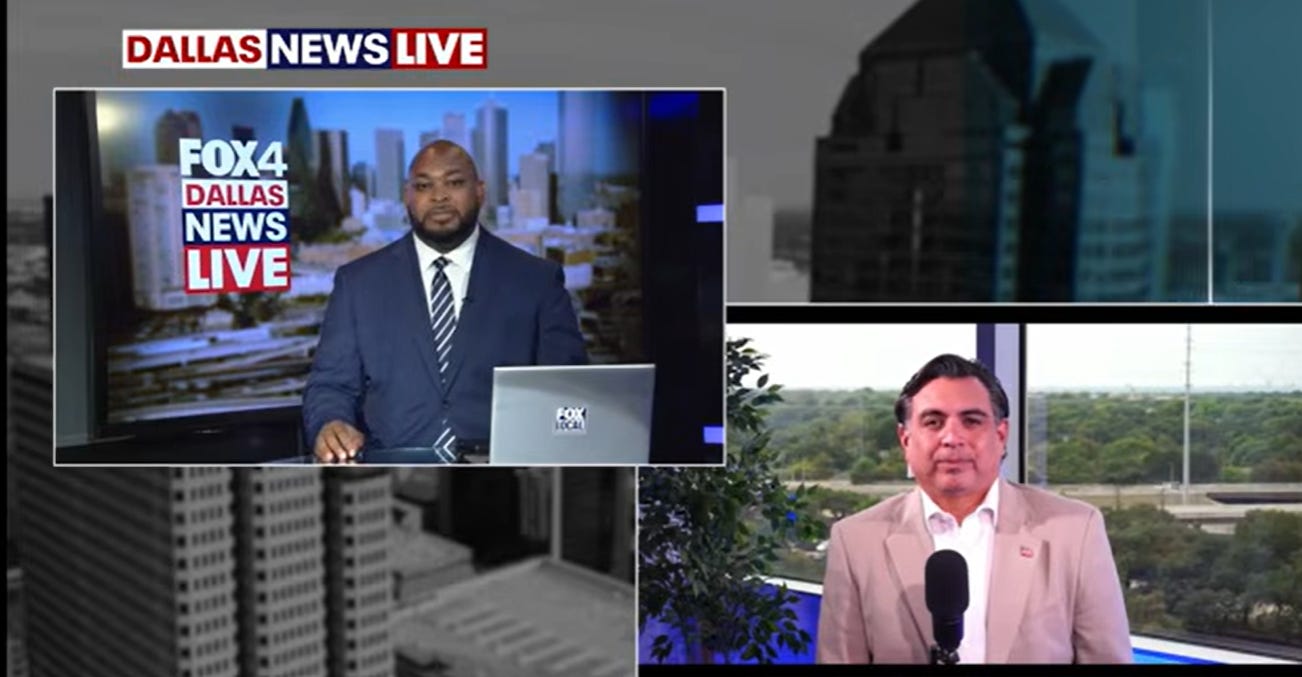
Gas prices remain a hot-button issue for Texans, with politicians promising quick fixes through federal tax suspensions and state-level relief measures. But what's really driving the pump prices that have frustrated drivers across the state?
In this informative interview, Pecos Energy’s President and oil and gas expert Rey “R.T.” Treviño III breaks down the complex factors behind today's prices—from geopolitical conflicts in Iran and Ukraine to the hidden gap between what refineries actually pay for oil versus what markets quote. He also weighs in on Governor Abbott's latest move to expand dyed diesel use and explains why some popular solutions might backfire.
If you've wondered why gas prices refuse to budge despite all the political talk, this conversation reveals what's really happening behind the scenes.
Key Points
1. Federal Gas Tax Suspension
The interview opens with a discussion about suspending the federal gas tax (8-10 cents per gallon). While Treviño acknowledges this would provide immediate relief at the pump, he notes that this tax funds the highway system. He expresses skepticism about a permanent repeal but supports a temporary suspension for near-term price relief.
2. Current Gas Prices & Market Factors
Steven Dial references AAA Texas data showing gas prices at $3.85/gallon (compared to $3.97 last week and $2.64 a year ago). The discussion explores why prices remain elevated despite political promises to lower them.
3. Geopolitical Conflicts Impacting Oil Markets
Rey “R.T.” Treviño III identifies the Iran conflict and Russia-Ukraine war as major factors driving oil prices. He explains how Ukraine’s bombing of Russian refineries (which produce the second-most diesel globally) affects global supply and pricing.
4. Physical vs. Paper Oil Prices
A key insight: while markets trade oil at ~$92/barrel, refineries pay $120-$135/barrel because of higher transportation costs, insurance, and shipping day rates. This gap significantly impacts pump prices.
5. State-Level Tax Initiatives
The conversation compares Georgia’s temporary state gas tax pause with potential Texas measures. Treviño notes that pausing Texas’s state gas tax could lower prices by another 10-15 cents but emphasizes the tax’s role in maintaining safe roads.
6. Dyed Diesel Expansion
Governor Abbott’s proclamation allowing expanded use of untaxed dyed diesel (for off-road vehicles like tractors and bulldozers) is discussed as a measure to help farmers, ranchers, and utility companies reduce costs.
7. Diesel Export Ban Proposal
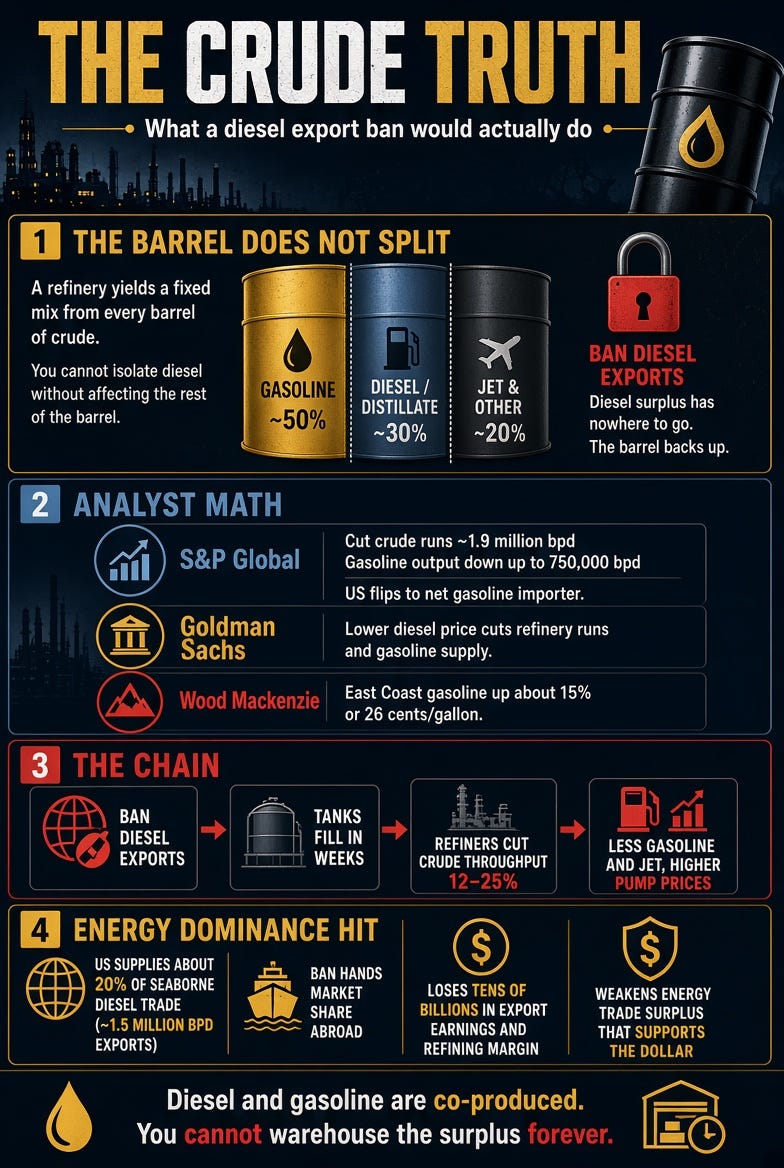
The interview analyzes President Trump’s consideration of a diesel export ban. Treviño argues this would likely increase domestic diesel prices rather than lower them, given Russia’s reduced refinery capacity from the Ukraine war.
We are tracking several key issues.
Europe has agreed to release its diesel reserves, slowing President Trump's threats of a ban.
Diesel is only one product from oil refining. If we ban diesel exports, and we are about 20% of the global exports, it would be a huge negative impact on the US Energy Dominance Push.
Diesel would back up, and refineries wouldn't keep running at current rates and would shut down, driving gasoline prices up.
8. Market Outlook & Price Corrections
Treviño predicts a market correction is coming, though he doesn’t expect significant price drops before the election. He questions whether prices will stabilize around $85 or $95 per barrel.
Again, we want to give Steven Dial with Fox 4 Fort Worth a huge shout-out. He ran a great interview with fantastic questions.
The Bottom Line:
We got to this point for several reasons.
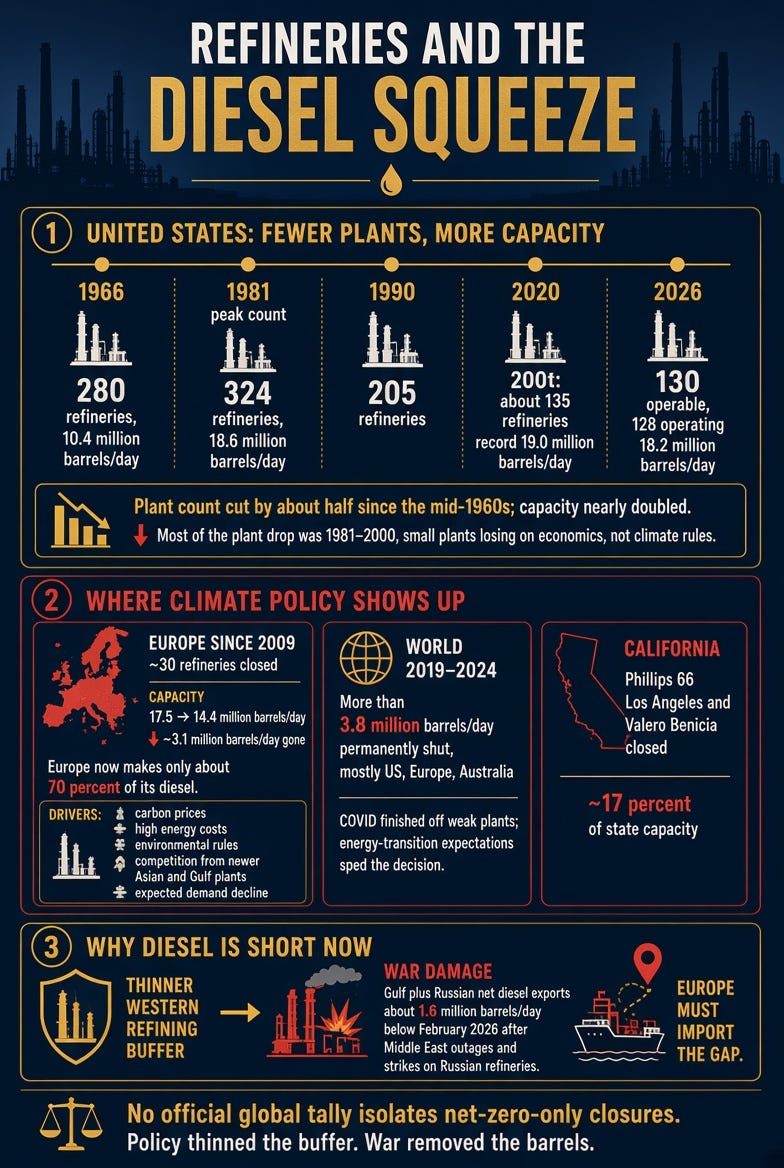
Net Zero has decimated the refineries globally.
Russia / Ukraine war has wiped out Russia’s export capacity, and they have banned exports.
China has shut down diesel, gasoline, and jet fuel again; they were picking up oil orders, but shut that down as well.
Iran and the Strait of Hormuz have globally shifted oil and gas markets to exporters focusing on areas outside choke points.
Oil is still getting through the Strait of Hormuz, but the Net Zero and deindustrialization side effect has absolutely eviscerated the refining markets.
The United States had 280 refineries, and due to Net Zero and Blue States, we are now down to 130, with only 128 operating. California has 7 refineries, and 5 are slated to close due to regulatory overreach.
India, Africa, and the US are now the global swing refining markets, and India is running at 103%, setting the stage for refinery accidents if it doesn’t get some maintenance time soon. That's a normal part of refining oil.
We have to get our Permitting Reform Moving in the United States and build more refineries, shipyards, and manufacturing. We can’t rely on others to make what we need for our own security.
Thank you to the sponsors of THE CRUDE TRUTH: LFS Chemistry, Texas Alliance of Energy Producers, Air Compressor Solutions, NAPE Expo, Energy News Beat, Exec Crew, Texas Star Alliance, Pecos Energy, and Real News Communications Network.
Subscribe to The Crude Truth for more conversations about energy, business, technology, and Texas's future.
For More information on Tax-Advantaged Investments: https://pecos.energy/info/
Check out LFS Chemistry, sponsor of the Crude Truth, here:
Air Compressor Solutions https://acsir.com/
Follow Rey on LinkedIn: https://www.linkedin.com/in/reytrevinoiii/
Also, Pecos Operating Website: https://pecos.energy/