

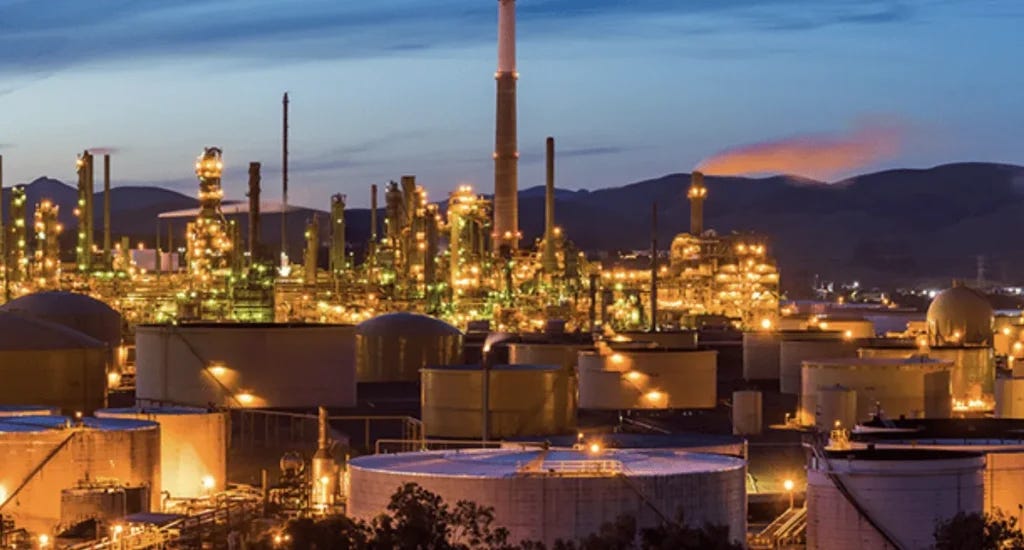
The Crude Truth about refineries.
On Oct. 22, ABC News ran a story titled “Gas prices unlikely to fall below $4 a gallon before midterms, some experts say.” It is a fair piece as far as it goes. It reports a national average of $4.27 a gallon, “an increase of nearly $1.30, or 43%, since the outbreak of the Iran war in February,” citing AAA. When ABC asked Denton Cinquegrana, chief oil analyst at Dow Jones Energy, whether prices could fall below $4 by Election Day, he said: “Short answer: No.”
This morning AAA has the national average at $4.266 and California at $5.996 for regular (checked 6:48 a.m. CT, Oct. 27). The national number has hardly moved since ABC’s story ran. California is about $1.73 a gallon higher.
What the story gets right
Crude drives the pump price, and the story says so. ABC reports Brent above $112 a barrel, “a rise of nearly 60% since the start of the Iran war,” and its analysts point to Middle East attacks on energy infrastructure and to the Russia-Ukraine war crimping Russian fuel exports. Those of us who produce the barrels see the same thing.
The story also explains why relief will be slow. Ramanan Krishnamoorti of the University of Houston told ABC that retailers sell through high-cost inventory and that “it’s usually a pretty slow downward trajectory for gas prices.” It notes that fall demand and winter-blend fuel usually help. None of that is wrong.
The sentence that deserved a follow-up
The most important line in the piece comes from Cinquegrana: “I’m sure you’ve seen everything about crude oil leaving the Strait of Hormuz at pre-war levels. The simple fact is that refined products are not.” ABC moves on from there. We would not. If refined products are the bottleneck, the next question is how much refining capacity we have kept at home. In California, the answer is less every year.
California’s disappearing refineries
Phillips 66 announced in October 2024 that it would close its Los Angeles-area refinery, saying the plant’s long-term sustainability was “uncertain and affected by market dynamics.” It ceased processing crude on Oct. 16, 2025. The EIA puts that plant at 138,700 barrels per calendar day and says its closure alone cut West Coast (PADD 5) refining capacity by 5%.
Valero’s Benicia refinery followed. Valero says it completed full idling of all processing units in April 2026 and will serve Northern California customers “through imports or other alternative supply arrangements.” The EIA lists Benicia at 145,000 b/d of crude capacity, and Valero cites 170,000 b/d of total throughput. Together, the two closures took about 284,000 b/d of crude capacity out of the state between October 2025 and April 2026.
The longer trend is just as clear. EIA data put California’s operable crude distillation capacity at 2.74 million barrels per stream day in 1982 and 2.01 million in 2020. On Jan. 1, 2026, it was 1.56 million, a 43% drop since 1982, and that figure still counts Benicia. The California Energy Commission’s current list totals 1,338,171 b/d across 11 refineries. The EIA notes there is relatively little pipeline capacity to move fuel from the Gulf Coast to the West Coast, so West Coast closures hit fuel supply harder there than closures elsewhere.
From where we sit, this is what happens when a state’s policy direction tells refiners their future there is uncertain. “Uncertain” was Phillips 66’s own word. ENB has argued that U.S. blue states are following the playbook that is closing refineries in the U.K.
Nobody builds new ones
The national picture is a slower version of the same story. The U.S. had 301 operable refineries in 1982 and 130 on Jan. 1, 2026. Capacity, though, held up: 19.0 million b/sd then and 19.2 million b/sd now, because existing plants got bigger. Even so, the EIA reports operable capacity fell more than 250,000 b/cd during 2025, to 18.2 million b/cd (EIA’s calendar-day measure; the stream-day figures above run higher). Two 2025 closures, Phillips 66 Los Angeles and LyondellBasell’s 263,776 b/cd Houston refinery (March 2025), together removed about 400,000 b/d, partly offset by small gains elsewhere, the EIA says.
The EIA says the newest U.S. refinery with significant downstream unit capacity is Marathon’s Garyville, Louisiana, plant, built in 1976 and online in 1977 at 200,000 b/cd. It now runs at 617,000 b/cd. Since then, smaller plants have been built, the newest being Texas International Terminals’ 45,000 b/cd refinery in Galveston, which started up in February 2022. The big gains have come from expansions at existing sites, such as Motiva Port Arthur in 2012 and ExxonMobil Beaumont in 2023. In nearly 50 years, nobody has built a large, fully integrated greenfield refinery in this country.
The other side’s case, fairly stated
There are real counterarguments. Crude is still the biggest single input to what drivers pay, and today’s spike began with a war, not a permit. Gasoline trades on a global market, so even a well-supplied U.S. feels Brent. That is the point ABC’s analysts make. Closures are company decisions, and Phillips 66 pointed to market dynamics. Expansions have kept national capacity roughly flat for decades, and the Gulf Coast still produces more fuel than it uses. Supporters of California’s policies would say the state is moving away from petroleum fuels by design.
All fair. But a market with less spare refining capacity, at the end of a long supply line, will spike higher and stay high longer when crude jumps. California’s premium over the national average this morning is the evidence.
Where an upstream operator lands
We produce crude oil. A barrel is worth nothing to a driver until a refinery turns it into gasoline or diesel. When policy pushes refineries out, and nobody builds new ones, the barrels we produce get refined somewhere else, and the cost of shipping them back lands on the consumer. Coverage of high pump prices should ask how we got here, not just what the war did this week.
Stu Turley of Energy News Beat has covered California’s fuel squeeze with Mike Ariza, Assemblyman Stan Ellis, Mike Umbro and Professor Mike Mische. ENB has also covered whether the Defense Production Act could reopen Benicia.
My Bottom Line
We are in a global refining shortage driven by decades of overregulation and the push to remove oil and gas from the markets. So, at a point where supply-and-demand basics are pushed to the front line, we have to ask: how did we get here?
We got here from a global desire to shut down the oil and gas industry. The Strait of Hormuz highlighted the bottleneck problems, Ukraine showed us how warfare is changing, and diesel and gasoline prices showed us that political leaders will blame everyone but themselves.
They all voted to wipe out the industry that feeds them, keeps the lights on, and builds new manufacturing.
So as we suffer through the political ads on TV, remember that the people throwing rocks are the ones who caused the problems.
We have lots of great episodes rolling out. On Thursday we will have “Texas Energy Independence, Oil & Gas, and the Future of Texas with Dawn Buckingham” out on all channels.
And that is The Crude Truth. I am glad that my family and I are part of the solution.
Sources (all accessed Oct. 27, 2026)
· AAA, national average gas prices (checked 6:48 a.m. CT)
· AAA, California average gas prices (checked 6:48 a.m. CT)
· U.S. EIA, “U.S. refining capacity decreased during 2025,” Today in Energy, June 29, 2026
· U.S. EIA FAQ, “When was the last refinery built in the United States?”
· U.S. EIA, Number of Operable Refineries as of Jan. 1
· U.S. EIA, U.S. Operable Atmospheric Crude Distillation Capacity (b/sd)
· U.S. EIA, California Operable Atmospheric Crude Distillation Capacity (b/sd)
· California Energy Commission, California’s Oil Refineries (data current as of July 8, 2026)
· Phillips 66 release, Oct. 16, 2024
· Phillips 66 release, Oct. 1, 2025
· Phillips 66 Q3 2025 earnings exhibit (SEC)
· Valero, Benicia Refinery page
· Energy News Beat, UK refineries / U.S. blue states
· Energy News Beat, Mike Ariza, “We Have Hit the Point of No Return…”
·