

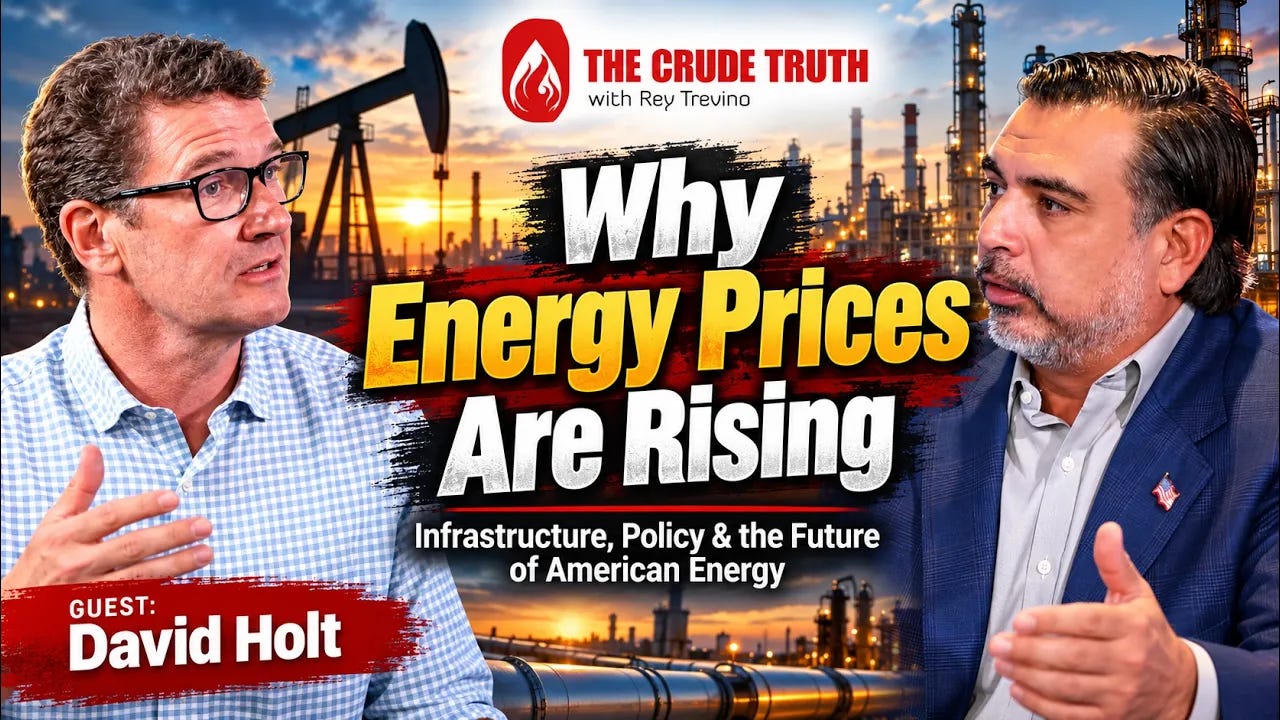
In this episode of "The Crude Truth," host Rey Trevino sits down with David Holt, President of the Consumer Energy Alliance, to unpack one of America's most pressing economic issues: why consumer energy prices have jumped more than 25% in just three years. While many blame rising oil prices, Holt and Trevino argue the real culprit is far more complex—a combination of aging infrastructure, regulatory barriers, and policy decisions that have strangled America's energy production and delivery systems.
Drawing on decades of energy policy expertise, Holt reveals how the U.S. squandered its historic opportunity to become the world's energy superpower, and more importantly, what must change to bring affordable, reliable energy back to American consumers.
From the critical need for new pipelines and refineries to the controversial role of data centers in Texas's energy future, this conversation shows how Washington's regulatory overreach costs everyday Americans thousands of dollars while threatening the nation's energy security.
1. Rising Energy Prices & Consumer Impact
The podcast opens with the central concern: consumer energy prices have risen over 25% in three years. The hosts explore whether this is due to oil prices, lack of infrastructure, or regulatory policy. David Holt emphasizes that policies directly impact consumers’ pocketbooks, particularly affecting small business owners and those living at poverty levels.
2. U.S. Energy Dominance & Global Position
David Holt highlights that the U.S. is the world’s #1 oil and natural gas producer—a dramatic shift from 20-30 years ago. This energy dominance helps keep global oil prices lower than they would otherwise be. The shale revolution is credited as a game-changer, allowing the U.S. to maintain production at ~14 million barrels per day.
3. Infrastructure Deficits
A major theme is the critical need for infrastructure expansion: transmission lines, pipelines, refineries, storage facilities, and desalination plants. ERCOT predicts electricity demand could double in Texas within 5-7 years, requiring massive infrastructure investment to prevent blackouts.
4. Regulatory Policy vs. Market-Driven Energy
The podcast contrasts red states (market-friendly policies) with blue states (restrictive regulations). States like California, New York, and Massachusetts have higher energy costs due to bans on natural gas and mandates favoring specific energy sources. Texas’s policy approach is praised as “the envy of the country.”
5. Refining Capacity & Diesel Prices
A significant discussion focuses on refinery restrictions. The U.S. has reduced from ~350 refineries in the 1980s to under 120 today, all running at 97-98% efficiency. Regulatory constraints prevent expansion, contributing to high diesel prices and the widening gap between diesel and gasoline costs.
6. Data Centers & Energy Demand
The podcast addresses concerns about data centers’ impact on electricity prices and water usage, while highlighting their benefits: telemedicine, improved logistics, national security, and local tax revenue. The solution proposed is using recycled water from oil production.
7. Environmental Progress in Energy
Despite criticism, the oil and gas industry is credited with significant environmental improvements since the 1970s—cleaner air, reduced emissions (SOx, NOx, PM, VOCs), and setting world standards for environmental safety.
8. Political Implications & Voting
The hosts emphasize that energy policy is a voting issue. They argue that voters moving to Texas from restrictive states should support pro-energy, market-friendly policies to maintain Texas’s competitive advantage.
Bottom Line: The podcast argues that rising energy prices stem primarily from regulatory restrictions and policy failures, not market forces—and that infrastructure investment and sensible energy policy are essential to affordability and reliability.
We are working on several episodes and an update on the global diesel crisis, rolling out by Saturday.
Guest: David Holt, President of the Consumer Energy Alliance. Connect with David on his LinkedIn: https://www.linkedin.com/in/david-holt-a207946/

Check out the Consumer Energy Alliance:
https://consumerenergyalliance.org/
For More information on Tax-Advantaged Investments: https://pecos.energy/info/
Check out LFS Chemistry, sponsor of the Crude Truth, here: https://lfschemistry.com/
Air Compressor Solutions https://acsir.com/
Follow Rey on his LinkedIn: https://www.linkedin.com/in/reytrevinoiii/
Also, Pecos Operating Website:https://pecos.energy/
Among America’s aging infrastructure are 130 operable petroleum refineries that make all the transportation fuels refined from raw crude oil for society. as well as the oil derivatives refined from oil that re the basis of more than 6,000 products in the economy.
PS: The same transportation fuels and products that wind turbines and solar panels CANNOT MAKE, as they can only generate electricity!
Among America’s aging refinery infrastructure is the technical talent running those 130 refineries, that are nearing retirement, and thus a shortage of talent to replace them is on the horizon.
Worldwide, there are around 200 total conventional refinery projects (comprising both new-build and expansion/upgrades) currently under construction globally. Thus, the refinery technical talent demand is primarily offshore.